Critical Success Factor 2: Content Distribution

chalk boarding drawing of content on being being distributed from one to another

While the first critical success factor in B2B sales involves the quality of your content, the ways in which that content is distributed to your audience is also important. Here are some key things to note regarding content distribution:

MediumKey MetricsDescription
EmailClick through rate, unique opensThe purpose of email is to produce awareness of something you want the recipient to notice. You want to point out a critical issue and direct recipients to where they can learn more about it.

Therefore, your email campaign must be designed to support your prospects’ desired process for finding solutions to their problems, as well as the vendors with which they want to partner.

Emails must be designed to get a click to where you can engage the prospect more. Of course, emails must be opened in order to get the click, but the opens alone tell you very little.

WebsiteInbound leads, search ranking, web trafficYour website’s number one role is to act as the central repository for the information your prospects need to determine that you should be on their short list of vendors they should engage to solve a particular set of their problems.

It is a powerful communication and content distribution tool and must be used as such. You must rely on your website to bring in leads straight to your sales team, as well as to nurture other leads for the long term.

You must know what key terms your prospects use to search, which pages are the most visited, and where they go from there. Continually optimize your website to attract, engage, and nurture prospects.tor

Social MediaFollowers, likes, sharesYour social media platforms (Facebook, LinkedIn, Twitter) are where you truly build your brand through. They allow you to create a community of loyal customers, employees, and future employees through regular content distribution.

Social media is the appropriate place for you to share your views that are more socially and politically oriented, such as environmental responsibility, diversity (cultural, racial, gender, age, etc.), and so on. It is a great place to post new job openings, have current employees discuss the importance and impact of those roles, etc.

In short, your social media properties are where you correctly position your company.

Read about the third Critical Success Factor, “Automation”.

Operational Excellence (Part 1): Marketing

Person looking on phone and writing on paper marketing statistics

The whole point of B2B marketing is to get your sales people onto the short list of vendors that a prospect is considering.

That can only happen if your marketing is compelling, which will only be the case if you have identified real problems you can solve. The process of identification is a lot easier if you focus on a well-defined group of customers that you fully understand, rather than going after a large number of prospects that you don’t really understand.

Focusing on a well-defined group of prospects is what makes marketing work. Everything else might as well be junk.

Objective(s)The number one objective of marketing is to get your prospects to actually reach out to your sales team. These are people who are ready to evaluate potential vendors. Their numbers are likely to be small—typically under 10% of your target market.

Next to that is fully engaging the remaining 90% and gradually converting them into Marketing Qualified Leads, or MQLs—people who are interested in finding out more, and may even be willing to meet with a sales rep.

Best PracticesAwareness→ Curiosity→ Interest→ Action

The process always starts with the prospect’s awareness: awareness of the extent of her own problem, that there is a solution to her problem, and that you have a potential solution. You want that awareness to be converted into a curiosity to find out more, and then an interest in learning more, which ultimately leads to some action—such as a willingness to attend a webinar, download a free trial, or talk with a sales rep.

In rare cases, the above journey might only require the first email you send out because the prospect is actively searching for a solution. In other words, she was already aware and interested before she even knew you existed. As soon as she finds a potential candidate, she is ready to meet and evaluate.

Most of your prospects, however, are not aware that they have a problem, much less the type or extent of the problem. If they are aware, they don’t really think the problem is a pressing issue. It is the responsibility of your marketing team to convert a mild and vague concern into an urgent one that must be dealt within sooner than later.

That is accomplished primarily by gaining a nuanced understanding of the prospect’s world through research, developing highly relevant and engaging content around it, and then distributing that content where the prospect is most likely to find it.

Key MetricsHere is what you are trying to find out: did your prospect come across your message (awareness)? Did she view it (curiosity)? Did she take further action after viewing it (interest turning into some type of action)?

Key indicators are (in the order listed): Emailing or calling you based on your marketing; attending or registering for a webinar; filling out a form; viewing a video; liking/following you on social media; clicking on a link; and opening an email.

Read about the second crucial operation of B2B Sales, “Prospecting”.​​

Critical Success Factor 3: Automation

Business women working on automating tasks

Both Marketing and Sales Automation are crucial to the success of B2B sales.

Marketing Automation

PurposeTo automate the creation and nurturing of a lead by delivering the right content at the right time based on action previously taken (or not taken) by the prospect.

To provide intelligence on the buying intent and readiness of marketing created leads and automate the handoff to the next step based on lead scoring and grading.

Used byMarketing
How it should workShould be set up to send targeted messaging to a targeted list in the right logical sequence, grade and score the leads based on the action they took and their profile (title, company size and industry, etc.), and automatically flag the right high-scoring leads in the system that Prospecting and Sales work with.

Sales Automation

PurposeTo automate, facilitate, and accelerate the time consuming and expensive one-on-one new customer-acquisition related activities in which your Prospecting and Sales teams typically engage.
Used byProspecting, Sales
How it should workMarketing Leads should only be made available in the CRM used by Prospecting and Sales when that lead is ready to be further qualified.

The system should enable the Prospecting team to see their high-priority work views (those they have already contacted but have not yet fully qualified) separately from their general prospecting pipeline (those they haven’t touched at all or are still pursuing to make first contact).

The final status of the lead here is SQL (Sales Qualified Lead), which means the lead is qualified and has agreed to a meeting with a sales rep.

The system should be able to do validation and ensure that all the necessary fields are filled out.

The system should automatically assign the lead to a sales rep and send the rep a notification email without the Business Development Rep having to do anything further than changing the status when all fields are completed.

Such automation ensures data integrity, accelerates sales, and avoids human error.

Figuring out how much to pay for Automation

There are several marketing and sales automation tools available, and at significantly varying prices. The question is, how much should you pay for a given automation tool?

The answer, generally, is that it depends on what you need—more capability and flexibility comes at higher prices.

However, we think that a better answer comes from considering its impact on the productivity of your various teams. Remember that your payroll is likely the single largest expense category for your company. You should seek to automate anything that improves productivity (improves the ability of the same employees to do more without working longer hours).

Here is a simple analysis to make the point. Let’s assume that your average, fully burdened salary for a member of your marketing/prospecting/sales team is $50,000 per year.

Product A is clearly far cheaper than Product B. However, Product B can improve productivity by 10% while Product A can improve productivity by only 5%. In the end, Product B is the superior value since the question is not just how much the product costs, but how much impact it has on your operations. The last line compares the two numbers by dividing the net value by $50,000 to arrive at the net productivity gains.

Product A Product B
Fee / user/ year ($)3001,800
Productivity Gains (%)5%10%
Productivity Gains ($)2,5005,000
Net gains ($)2,2003,200
Net gains (%)4.4%6.4%


The Issue with Data—What is too much versus too little

One of the recurring problems we come across is that the management’s need for data is at odds with its need for employees to keep their work simple and efficient. If you want a lot of data, then you are asking your people to spend more time on data entry and less time on what should be their primary work. Automation can help free your employees from carrying out mundane, repetitive tasks, allowing them to do more valuable work.

The key is to get the data you need as a natural outcome of the work they do. This is a lot easier said than done, and any system that you use must be thoroughly evaluated before implementation.

The first step is to identify the essential data you need to qualify a lead and move her through your sales stages. This should not require much data, but it should be clear to all your teams that without this information, they are likely to waste a lot of time and effort trying to engage the wrong people.

On top of that, there may be additional data you want to collect, but be judicious and let employees provide this in a free text format rather than forcing them to enter into discrete fields. You are far more likely to get useful information this way, since forcing them to enter data could prompt them to just click on something to get past your validation.

The end goal is twofold: to provide employees with reports and dashboards that help them manage their day-to-day productivity, while you gain insight on what is working and what isn’t.

Make these two goals converge, and you will have plenty of high quality—and useful—data.

Read about the final Critical Success Factor, “List Management”.

Revenue Growth Decision Point: Build or Buy

Business man trying to make a decision for revenue growth

As you can see, there is a lot that goes into building and maintaining the operational excellence necessary for generating consistent revenue growth. Not only does a company need to produce high quality and compelling content regularly, but it must also continually distribute this content to its targeted audience, track engagement, make necessary adjustments, and pass those that are ready to the next operations team. Building a marketing team is expensive, and therefore a big decision point that management needs to make is to build or buy. 

To Build or Buy?

A common mistake that many companies make is to think that to improve their revenue growth, they can hire one or two people who will take on the various roles shown in the chart to the right. It doesn’t seem to work out that way, no matter how hard the marketing team tries to learn and master these various disciplines.

Position Salary/yr.  
Marketing Head$108,000
Researcher$45,000
Copywriter$84,000
Graphic Designer$84,000
Video/animation$84,000
Social Media$60,000
Email marketer$60,000
SEO specialist$60,000
Prospecting Head$84,000
BDR$55,000
Sales Support$45,000

A better alternative is to keep your marketing team lean with just the Head of Marketing, who is responsible for developing your marketing strategy, and a smart, energetic product marketing manager who will work with sales to develop product marketing campaigns and push for revenue growth.

With your internal team controlling your marketing and revenue growth, strategies, and metrics, you can now work with a partner to provide you with both the Marketing Operations and Prospecting Operations deliverables you need for revenue growth.

This approach gives you the following benefits:

Focus. You focus all hiring where it matters the most—on those that are integral to the design and development of your products and services.

Rent-to-own. You let others make the required investments toward achieving the operational excellence that is necessary to deliver the quality and quantity of results that you need for revenue growth.

It is the classic case of paying for what you use, rather than for the infrastructure needed to deliver what you use.

We Can Help You with Revenue Growth

SOMAmetrics is a sales productivity enhancement consulting company that enables client companies to experience revenue growth by fixing three critical sales hurdles—insufficient sales pipeline, low conversion rates, and access to new markets.

We provide the best practices, new market research, SEO, digital marketing, sales enablement, performance metrics, and sales and marketing automation services that clients need to consistently achieve revenue growth.

Our best practices, systems, and processes have been honed through working with over 100 small and mid-sized B2B companies serving a wide range of industries including: Financial Services, Education, Healthcare, Manufacturing, and Data Centers.  Please contact us today:

Phone510 206 9264
Emaileskinder@somametrics.com
Websitewww.somametrics.com

Critical Success Factor 4: List Management

list management in B2B sales operations

In Critical Success Factors 1-3, we discussed the importance of Content, Content Distribution, and Automation in the operation of B2B Sales. Here, we discuss the final factor, List Management.

CharacteristicsImportance/Impact
Duplicate recordsYou will find that duplicate records are inevitable as you begin performing list management. However, they pose a significant problem and must be continually managed. At any given time, you should strive to keep your duplicate records at under 1%.

Duplicates happen when your marketing team uses different sources of lead acquisition and enters leads into your database without first checking for duplicates. Sometimes marketing does this in order to keep a prospect in multiple marketing lists. However, there are ways to do that without creating duplicate records.

Opt outsA key aspect of list management is ensuring that someone who opted out of one of your marketing programs is opted out of all, unless the recipient chose to opt out of specific marketing programs.

You should treat opt-outs very seriously. If you receive even a handful of spam complaints, you could become blacklisted, which means you would not even be able to send emails internally to each other until you clear yourself from the blacklist.

BouncesEmail bounces occur when mail can’t be delivered—this can be because the person is no longer at the company; she created a false email address just to get something she wanted; or because she created a temporary email for such a purpose, and it is no longer active.

You must keep your lists clean on a regular basis as bad records give you an inflated representation of your actual audience size. Too many bounces can also cause you to be flagged for blacklisting. Proper list management can help prevent such email bounces and blacklisting.

Email validationIf your sales reps bring a list of prospects with emails and claim that these prospects wish to receive marketing emails, they should first be validated before being placed in your system. There are online email validation tools that start at $14/1,000 records, and the prices drop for larger list sizes.
List segmentationThis is perhaps the hardest part of list management—keeping a tight control of the audience so you can send highly targeted messages. For example, you want Jim Jones to be part of your overall monthly newsletter, but you also want to keep him on your Hospital CIO list and your overall CIO lists. What you don’t want are three records of Jim Jones—you just want Jim Jones to be in all three marketing campaigns.

As you can see, a lot of work goes into creating engaged marketing audiences that are more inclined to meet with your sales reps, thereby providing you with a consistently high quality and quantity of sales pipeline. You may need help with such list management. The next section covers that.

Giants like General Motors Know the Advantages of Outsourcing

general motors advantages of outsourcing

General Motors Has Not Made a Car in 70 Years

And I respect GM for that.  It would be foolish of them to not know the advantages of outsourcing and do the whole job.  Let me explain.

GM does what is strategic and outsources the rest – as it should.  The company designs cars. It details the specifications for its powertrains, brakes, lights, electrical systems, tires, etc. but – and this is a big but – it doesn’t make any of them. It buys its tires from the big tire manufacturers. It buys its batteries from the big battery companies. It buys its brakes from the best-of-breed brake manufacturers. But it doesn’t even try to compete with companies that are superb at making the components of a car.  Instead, it buys from them.

To Get the Advantages of Outsourcing you Must Understand Core vs. Context

GM understands the difference between core and context. Core are functions that make a genuine difference in the marketplace; context is everything else. Context are the things that need to be done well but don’t deal directly with marketplace success.

Office buildings are context.  Accounting is context.  Designing windshields is core but manufacturing them is context.

Successful companies intuitively recognize the difference between core and context. They focus their energies on what really makes a difference and they outsource the rest.

Marketing Strategy is Core; Marketing Operations are Context

Only management can decide which markets it wants to pursue and how it wants to pursue them.  Only management can determine its product and service pricing. Only management can develop the company’s marketing strategy. Its marketing strategy is core.

But the company is not going to be recognized in the market for its excellence in installing and operating SalesForce.com.  No company will generate great profits because it did a good job scrubbing its email lists. The company’s stock price will not budge because it wrote a good piece of marketing collateral that an agency could have written.

A prudent company will focus its energies on marketing strategy and outsource its marketing operations. The reason is simple. One of the advantages of outsourcing marketing operations is that companies that focus on marketing operations need to be expert at it.  They need to know how to write compelling copy, layout a persuasive website or brochure, and deliver the corporate message cost-effectively through a wide range of channels. They need to understand the full range of digital software sales and marketing tools and know exactly where they fit in a campaign. Some of these tools are best for small companies and others are best for large companies. Marketing operations experts know which is which.

Most companies, particularly small and medium-sized ones, can’t afford to develop this expertise – and they shouldn’t. Just as those companies outsource their legal work to legal firms, outsource their accounting work to accounting firms, and outsource their janitorial work to janitorial companies, they should also outsource the implementation of their marketing strategies to boutique firms that live and breathe this sort of work.

It just makes sense.  Companies should only do what they do best and makes a difference in the marketplace. The rest should be outsourced.

Optimizing Content Marketing Strategy with White Papers

You have in your possession a well-researched, highly engaging white paper— now what? White papers are not intrinsically beneficial to your overall content marketing strategy if you do not promote and leverage them properly. When it comes to successfully using your white paper to generate leads and secure sales, there are three necessary steps you should follow:

Step 1: Create a Proper Landing Page

More often than not, a company’s white papers are deeply hidden within their website. To even reach the white paper, potential buyers are forced to navigate through several web pages. Once buyers find the white paper landing page, it is often lackluster: failing to provide any compelling reasons for downloading and reading the paper.

To maximize your content marketing strategy, it is important to dedicate a page to your white paper. This landing page should highlight the benefits of reading the white paper, assuring potential buyers that downloading and reading your insights is worth their time and energy.

An impactful and effective white paper landing page should have the following elements:

  • Keywords – it is well-known that SEO optimization is key to drawing traffic to your website, . Begin  by selecting the keyword of your company’s choice and ensuring that it is included multiple times on your website’s various pages. Once you have selected your relevant keyword, a rough guide for your white paper landing page is to aim for a keyword density of between 2-7%.
  • Minimal text – The biggest bulk of text on your white paper landing page should be the introduction paragraph. This paragraph should include a catchy and attention-grabbing headline to draw the reader in, as well as a sentence or two outlining the contents of your white paper
  • Emphasize benefits – All other text on your landing page, excluding your introduction paragraph, should be bulleted. Bullets provide readers with essential information in a quick, streamlined way. These bullets should focus on emphasizing the “what” of your white paper— what are the benefits of downloading and reading this paper? If you cannot convince visitors on your landing page that they will be better off having read your white paper, they will not bother to download it.

Step 2: Collect Information for Content Marketing

When it comes to granting access to your white paper, you have two options: a direct link or gating your content with a form. The smartest option for boosting your content marketing strategy is to offer your white paper in exchange for personal information.

Asking your visitors for information allows you to generate valuable leads. By gathering the names and e-mail addresses of your visitors, you can more easily convince them to opt-into your marketing efforts— your future emails, newsletters, and blog posts. Acquiring your visitors’ information and establishing a relationship with them through sharing your marketing content results in a greater likelihood of successfully incorporating them into your sales funnel.

It is tempting to ask potential buyers for as much personal information as possible— resist the urge. Asking visitors for too much information up front, risks alienating them. Since first time visitors to your company’s website have no personal connection with your company, they most likely wouldn’t want to spend too much time filling out forms.

To increase the prospect of collecting visitors’ information and connecting with them in the future, keep it simple— only ask for their name, company, and e-mail address.

Step 3: Bring Content Marketing to Social Media

As of 2018, there are over 3 billion active social media users worldwide— that’s nearly 40% of the global population. With such a large, easily accessible pool of potential leads, you would be remiss to not include social media in your white paper’s content marketing strategy.

Social media marketing is vastly important in gaining visibility and driving traffic to your website. 90% of marketers claim that white paper social media marketing has generated immense exposure for their company [i]. By posting engaging and informative content on social media, businesses are more likely to see click-throughs to their website. This increased visibility yields a greater number of leads generated and conversions, as over 66% of marketers see lead generation benefits with social media usage [ii].

The best approach to promoting your white paper in addition to attracting attention to your business as a whole is through the adoption of social media into your content marketing strategy.

Selling More to Existing Customers (Quadrant 2)

crew members assisting existing customers

This article is part of our “Four Quadrants for High Growth Quick Start Guide”.  Click here to access the full series.

Quadrant 2 Goal: Increase Usage from Existing Customers

Overall Goal: Increase usage of existing customers by an average of 5-10%

SOMAmetrics-Quadrant-2
Four Quadrants- Quadrant 2


Quadrant 2 consists of existing customers who already buy a particular product. The goal here is to influence these customers to order more of what they are already buying. If you sell software licenses, can you persuade them to subscribe to more licenses? If they buy boxes of widgets, can you get them to order more boxes?

Regardless of the product your aim is to increase customers’ consumption of that product by a targeted amount. If you are selling software licenses, can you increase the average license purchase per customer by ‘x’ amount? If your customer orders 100 boxes of widgets a year from you, can you increase that to 110 boxes? And how do you do that?

This is a low-touch sales environment. You want to simplify and standardize your operations, automating as much of it as you can. Your sales operations should  resemble a self-serve portal in which customers can order what they want, when they want. Ensuring this kind of consumer behavior requires continual and targeted marketing strategies

Below you will find some important tips on optimizing sales and marketing in this quadrant.

Marketing Optimization

GOAL

To reiterate, the objective  is to automate all marketing to continually touch existing customers and give them new reasons to buy more of the products they are already using.

KEY OPTIMIZATION ACTION ITEMS
  • Continually envision new ways for customers to use your existing products
  • Constantly update customers about new features that increase ease of use and efficiency
  • Offer additional promotional incentives to increase usage–price savings on additional purchases, discounts on other products, etc.
  • Make certain premium services free for customers who purchase  higher volumes
  • Send at least one promotional email campaign each month to make sure you stay front-of-mind


Sales Optimization

GOAL

Increase Sales of existing products to existing customers

Ideally, Quadrant 2 sales can be completed without the help or involvement of a sales rep.

KEY OPTIMIZATION ACTION ITEMS
  • Make it very simple for customers to order more and for orders to be fulfilled immediately
  • Automate price quotes, contracts, and ordering
  • Automate workflows to send orders to fulfillment as soon as contracts are signed

Selling New Products to Existing Customers (Quadrant 3)

two people discussion how to sell new products to existing customers over coffee

“How to Sell New Products to Existing Customers” is part of our “Four Quadrants for High Growth Quick Start Guide”.  To access the full series click here


Quadrant 3: Introduce new products

Overall Goal: Increase the number of products that each customer uses by 15-20% each year.

SOMAmetrics Quadrant 3
Four Quadrants- Quadrant 3

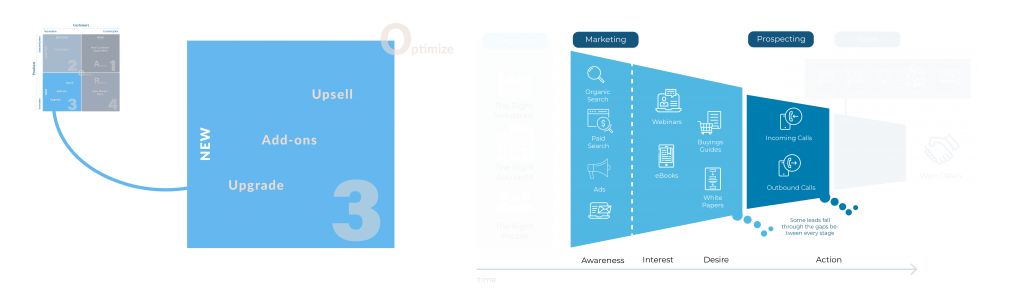
Quadrant 3 is all about selling products and services you offer that your customers have not yet purchased. The most important of these are Upgrades, Add-ons, and Bundles or Packages. Quadrant 3 offers some highly attractive growth opportunities for a company that is set up to take advantage of it.

Below you will find a Best Practices checklist for optimizing high growth within Quadrant 3 for Marketing, Sales, Customer Service, and Innovation.


Marketing Checklist

GOAL

Continually market to current customers by demonstrating how the value of their existing products increases significantly when used with another product that you sell, but that they don’t currently use.

KEY OPTIMIZATION ACTION ITEMS
  • Have an accurate database of which customer has which products installed.
  • Build an automated marketing strategy? system? that works on the logic: “If a customer has product A, then use Campaign X. If a customer has products A and B, then use campaign Y”, and so on.


Sales Checklist

GOAL

Build an effective account management team that excels at selling new products to existing customers with the goal of increasing revenue per customer.

KEY OPTIMIZATION ACTION ITEMS
  • Set up an account management system that uses the marketing database to call on customers to cross-sell and upgrade them to higher tier products.
  • Build your compensation plan to reward such account penetration.


Customer Support Checklist

GOAL

Make customers highly successful at using your new products within 30 days of acquiring them.

KEY OPTIMIZATION ACTION ITEMS
  • Build a library of training material and resources to enable customers to teach themselves to use new products.
  • Build scalable support infrastructure such as chat and self-help portals to provide quality customer support with less impact on the Support organization.


Innovation Checklist

GOAL

Introduce new products and services on a regular schedule—at least every 2-3 years.

KEY OPTIMIZATION ACTION ITEMS
  • Set up a Product strategy team that continually reviews the product pipeline and prioritizes new projects.
  • Set up agile development practices to enable rapid and iterative releases of products to enable quick changes based on shifts in customer priorities and preferences.
  • Set up Product Management to translate big initiatives that come from Product Strategy into clearly defined tasks that are implemented through the agile development process.

Increasing Your Customer Base (Quadrant 1)

two motivated people working hard on their laptop and tablet

“How to Increase Your Customer Base with 4 Handy Checklists” is part of our “Four Quadrants for High Growth Quick Start Guide”.  To access the full series click here


Quadrant 1: Increase Customer Base

Overall Goal: Increase the number of your customers by 15%-20% per year

SOMAmetrics-Quadrant-1
Four Quadrants- Quadrant 1


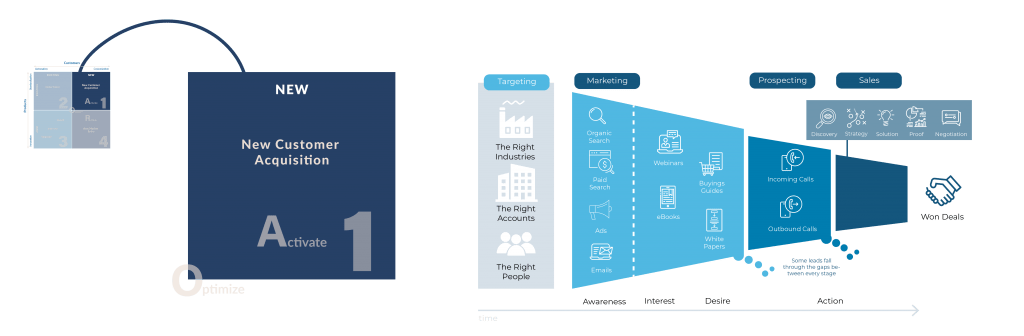
Quadrant 1 Sales is what most companies think of when they talk about revenue growth—increasing your customer base numbers. In fact, many of the companies we work with invest so much time, effort, and money into Quadrant 1 that they neglect Quadrants 2 and  3.

At the same time, most of these companies do not use the most critical strategy for farming in Quadrant 3: Four Funnel Framework. This is the most important strategy for winning new customers because it ensures tight integration of Sales and Marketing efforts. We will discuss the Four Funnels Framework in more detail in the next section.

Below you will find a Best Practices checklist for optimizing high growth within Quadrant 3 for Marketing, Sales, Customer Service, and Innovation. 

Marketing Checklist

GOAL: Deliver the necessary number of Marketing Qualified Leads.

KEY OPTIMIZATION ACTION ITEMS:

  • Define the marketing content (assets) necessary to drive prospects through the various levels of interest: awareness, understanding, acceptance, preference, and conviction. The marketing assets must deliver the first three stages to generate Marketing Qualified Leads (MQLs)
  • Build the automation that scores the activities of very early prospects and provides them with more marketing assets until they score high enough to be MQLs ready for handoff to the Tele-prospecting team

Sales Checklist

GOAL: Increase the number of customers by 15-20% per year.
KEY OPTIMIZATION ACTION ITEMS:
  • Define the qualification criteria that makes a Sales Qualified Lead (SQL).
  • Develop the qualification and SQL acceptance process and build it into the Sales Operations and Sales Automation system.
  • Automate the handoff and notification process so that Sales immediately follows up on SQLs.
  • Build the right compensation plan that rewards progress through the Sales Cycle so that deals do not get stalled in the middle.
  • Build the right comp plan that rewards hunters for getting even small deals in key accounts that have significant upside potential.

Customer Support Checklist

GOAL: Convert new customers to happy and fully satisfied ones within the first 2-3 weeks.
KEY OPTIMIZATION ACTION ITEMS
  • Design the new customer onboarding process to be as quick and as painless as possible.
  • Develop a scorecard that identifies the components of onboarding a new customer and rates the new customer onboarding team along each component.
  • Map the components of the scorecard into the customer support system and processes so that agents can do their work with a high level of efficiency and accuracy.

Innovation Checklist

GOAL: Make your products easy to learn, use, and support in order to free up scarce resources for new products.
KEY OPTIMIZATION ACTION ITEMS
  • Review your current products and determine how they can be centralized, standardized, componentized, and optimized so that they are easy to sell, support, and use.